As a strategist, I have a similar conversation with e-commerce or B2B business owners almost every week. It usually goes like this: "We burned through tens of thousands of zlotys on Facebook and Instagram. The agency says clicks are cheap, but no one is buying. Who is right?"
Then the finger-pointing begins. The graphic designer claims the banners are beautiful. The ads specialist shows screenshots from the manager indicating a high CTR (Click-Through Rate). The developer swears the website is working correctly. And at the end of the month, the company's cash register is still empty.
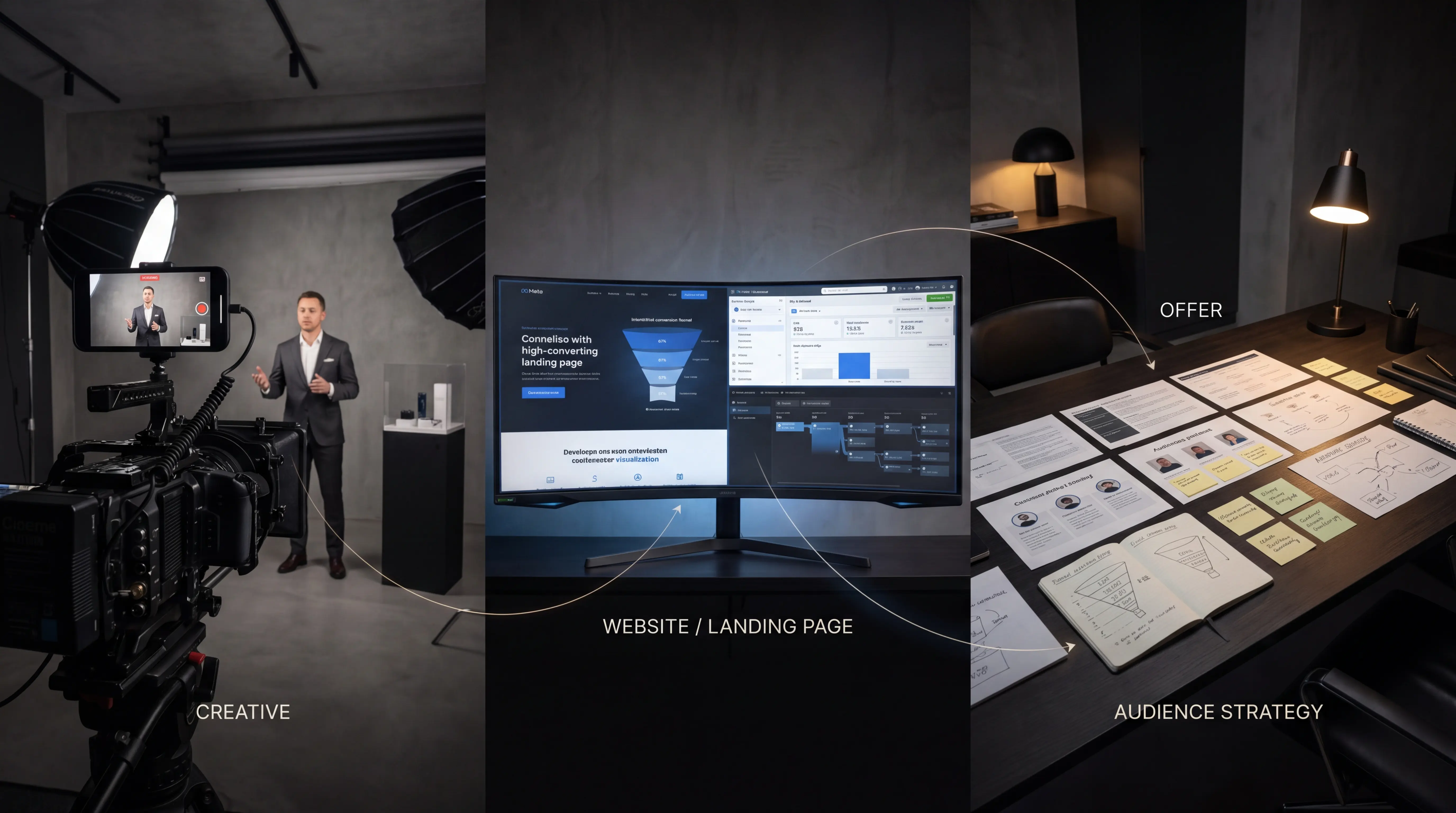
The truth about Meta Ads is brutal but simple: advertising is not magic; it is math and psychology. When we divide a campaign into isolated parts (someone does the graphics here, someone builds the website there, and someone else "clicks it all together"), we are dooming ourselves to failure from the start.
To understand what actually determines the success or failure of a campaign, we need to break this ecosystem down to its primary elements. Let's look at what the advertising reality looks like in 2026 and where your money is most often leaking.
Deconstructing the Campaign Ecosystem: What Really Matters?
1. The Offer (The Foundation) – You Won't Move Without It
We very often confuse the offer with the price or the product. An offer is not "sports shoes for 299 PLN" or "a legal audit for companies." An offer is a promise of transformation, a reversal of risk, and the reason why the customer should buy right now, exactly from you.
- Bad offer: "Accounting for LLCs. Call us."
- Good offer: "We will take over your accounting in 48h. The first month is 50% off, and if you find a mistake in our calculations—we refund your money."
Even the best Meta algorithm and a brilliant video will not sell a service that the market simply doesn't want or that gets lost in a sea of identical messages from the competition. If no one is reacting to your ads, the problem usually doesn't lie in the buttons within the ads manager, but in what you are trying to sell.
2. The Creative (The Engine) – It Does the Targeting Now
Just a few years ago, the most important thing in Meta Ads was finding that "hidden" target audience. Today, that's history. Thanks to artificial intelligence solutions (like Advantage+ campaigns), Meta's algorithms are smarter than any specialist.
Nowadays, the creative (graphics, and especially short, dynamic videos) determines who the ad reaches. If your video on TikTok or Instagram Reels starts with the sentence: "Do you run an online store and struggle with abandoned carts?", the algorithm will find e-commerce owners who will keep their eyes on that message for more than 2 seconds.
The creative is your main targeting tool today. It must be authentic, native (not looking like a cold, TV commercial), and strike directly at the customer's pain point.
3. The Website (The Cash Register) – A Black Hole for the Budget
This is the point where most highly promising campaigns fail. The ad on Instagram did its job—it piqued the customer's interest. The user clicks, goes to the website, and... hits a wall.
Why do good ads fail to convert?
- The site takes 6 seconds to load on a smartphone (the customer leaves after 3 seconds).
- The promise from the ad (e.g., "Download the free guide") doesn't match what is on the landing page (the client lands on the homepage and has to look for the guide themselves).
- The contact form has 8 fields to fill out, including Tax ID and job title.
- A lack of social proof to alleviate purchasing fears.
At Innova Creative, we often refuse to launch paid campaigns if a UX/UI audit shows that the website resembles a leaky bucket. Pouring water (traffic) into it defeats the purpose.
4. Target Audience – The Myth of Precise Targeting
In 2026, narrowing the target audience down to "people aged 25-34, who like golf, coffee, and expensive watches" is usually a mistake. Such actions artificially inflate the cost of reach (CPM). Trusting Broad Targeting and letting the algorithms learn based on who clicks the creative and converts on the site is the only sensible way to scale a business today.
Problem Diagnosis: Where is Your Campaign Breaking Down?
You don't have to be an analyst to understand where the budget is leaking. Just look at a few metrics in the right context. I have prepared a simple diagnostic matrix:
| What does the Ads Manager say? | What happens on the website? | Probable cause |
|---|---|---|
| Nobody clicks (low CTR), the ad is expensive | No traffic | Weak creative (doesn't grab attention) or a boring offer. |
| Lots of cheap clicks (high CTR) | Lots of visits, but a high bounce rate and nobody buys | Bad website (UX/UI), long loading time, or the site doesn't answer the ad's promise. |
| People add to cart, but don't buy | Lots of abandoned carts | Weak offer at the finish line (e.g. expensive shipping costs added late) or lack of trust in the payment gateway. |
| The ad worked great, then suddenly stopped | Conversion drop after a few weeks | Creative fatigue. The target audience is used to your video/graphic. Time to record new ones. |
Pre-launch Meta Ads Checklist: Don't Launch a Campaign Without This
Before you invest another few thousand zlotys in ads, make sure you have the basics covered:
- The 3-second test: Does my creative (video/graphic) clearly communicate the benefit within the first 3 seconds?
- Consistency: Does the headline on the landing page 100% match the promise from the ad?
- Mobile usability: Have I gone through the purchase/form completion process myself on my phone without a shadow of frustration?
- Offer: Do I have a clear answer to the customer's question: "Why should I choose you over Company X, which I saw on Google yesterday?"
- Analytics: Are my Meta Pixel and Conversions API (CAPI) sending correct data from the website so the algorithm can learn?
The Growth-Partner Perspective
Understanding that Meta Ads is not an isolated entity, but part of a larger ecosystem, is a breakthrough moment for many business founders. You don't need a "Facebook magician" to click hidden options. You need a strategic view of the entire customer journey—from the first second of a video on a phone, all the way to the "thank you for your purchase" page.
That is why at Innova Creative, we are not just an "ad agency." When we work on growth, we analyze your funnel comprehensively: we verify website usability (UX/UI), create engaging content (video/photo), and only then scale it with properly tailored campaigns. Because only the synergy of these elements builds predictable profit.